Accurately monitoring and handling contributions is essential for any nonprofit organization. The regulations for charitable contribution deductions evolved with the enactment of the Pension Protection Act in 2006. Previously, check registers or personal notes sufficed as documentation.
Save 10% on every ebook, spreadsheet & package on this site
Use code FCA at checkout
Browse the full list from the Packages menu above.
Now, all donations require evidence for deductions. This proof can be a bank record or a donation receipt.
Acceptable bank records for this purpose include bank or credit union statements, canceled checks, or credit card statements. They must display the payment date, charity name, and payment amount.
For any single contribution of $250 or more, a donor cannot claim a tax deduction without a contemporaneous, written acknowledgment from the recipient organization.
"Contemporaneous" means existing or occurring in the same period of time. Per IRS Publication 1771, to qualify as "contemporaneous with the contribution," the donor must receive the acknowledgment by either:
- The date of filing the individual federal income tax return for the contribution year
- The due date (with extensions) of the return.
Donation Guidelines Package
A set of 4 ebook packages that covers many of the following topics...
- How to handle and receipt stock donations
- How to handle free rent and labor donations
- How to handle non-cash contributions
- What to do if you receive a DAF (donor advised fund) contribution or grant
- How to handle Quid Pro Quo donations and other fundraising income such as drawings and raffles
- Donation policies and procedures
- Much more - Click here for details
 Add to Cart Secure instant download
Written Acknowledgments for Contributions:
According to the IRS Pub 1771:
The donor is responsible for obtaining a written acknowledgment from a charity for any single contribution of $250 or more before the donor can claim a charitable contribution on his/her federal income tax return.
However, the IRS does require you as a charity organization to provide a written disclosure to a donor who receives goods or services in exchange for a single payment in excess of $75. See more about those Quid Pro Quo Donations in Book 4 (Stock & More Unique Donations) of my Donation Guidelines Package.
So it is at the discretion of your church policy to issue annual contribution statements or make them available upon request.
Requirements for a Contribution Receipt:
The receipt must include the Church's or Nonprofit's name, the donor's name, the date(s) of the donation(s), and the amount(s).
It must also contain a statement explaining whether the charity provided any goods or services to the donor for the donation. If no goods or services were provided, you would include wording such as:
"You did not receive any goods or services in connection with these contributions other than intangible religious benefits".
An annual contribution statement will satisfy this requirement for churches.
You should send your donors a receipt no later than the due date of their tax returns.
However, if you are issuing receipts on an annual basis, you should try and get them to your donors by at least January 31st each year and earlier in January if possible. This will assist your donors in gathering necessary data for their tax preparations.
Important Charitable Contribution Receipt Rules!
Frequency:
Your donation receipts or acknowledgments can be issued gift-by-gift, monthly, quarterly, annually, or any other frequency. This is up to your organization. If you have a policy and procedure manual, the frequency should be recorded there.
Form:
There is no specific design of the receipt required...EXCEPT for form 1098-C, used for gifts of autos, boats, or airplanes.
The receipt can be a letter, postcard, or a computer-generated form. It does not have to include the donor’s social security number or other taxpayer identification number...but it must include the required information listed above.
A receipt can also be provided electronically, such as via an email addressed to the donor.
Report and Value:
A written receipt should be issued for all non-cash donations. Usually, your organization is not responsible for establishing the value of the non-cash items and should not include any value on the receipt.
However, a new tax law adopted in 2004 requires extra documentation from your organization for donations of qualified vehicles (including automobiles, boats, and airplanes.
For detailed instructions...look on the IRS website and purchase my Donation Guidelines Package!
Bookkeeping for churches involve meticulous attention to detail, transparency, and understanding of financial principles. Challenges include accurate record-keeping, compliance with tax regulations, and clear communication with church leadership and congregation.
Gifts:
Usually, gifts by church members to pastors, specific needy individuals, and specific church employees do not qualify for a charitable contribution deduction and should not be included on the donor's annual contribution statement.
See this page for more love offering guidelines.
How to set up and administer a Benevolence Fund!
Donated Labor and Service Contribution:
See more on setting up and properly administering a Benevolence Fund in the Church Accounting How To Guide
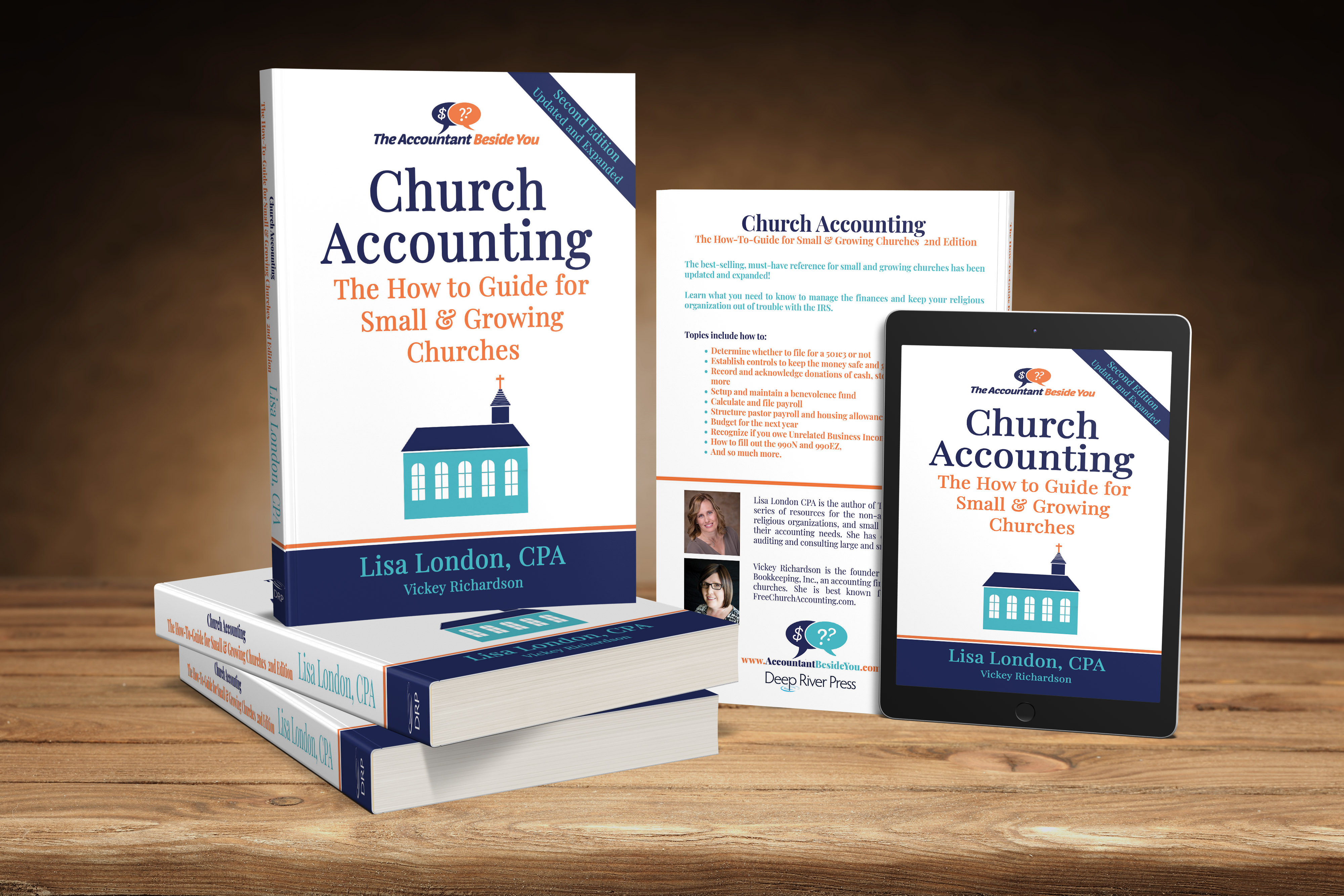
Includes:
- requirements for payments
- discretionary benevolence funds
- benevolence for employees
- disbursement procedures
- written benevolence policy example and much more
The IRS does not permit a tax deduction for donated labor or services. However, a donation receipt may be issued for donated materials and other out-of-pocket expenses.
Say...a repairman voluntarily came and fixed your church's air conditioner. He usually charges $75 per hour for his labor and he spent $50 for parts.
You can issue him a receipt for the parts; however, his labor is a generous non-deductible gift to the church. Also, he can deduct his mileage to the church and back if he itemizes on his personal taxes. However, your donor should be aware that he cannot claim the parts as business expenses AND a tax deductible charitable contributions!
Un-reimbursed expenses that volunteers incur while performing their volunteer services can generally be deducted from their personal tax return.
Important note: If their volunteer’s expenses exceed $250, they should receive a letter from your organization indicating the type of services they provided. The letter should not include the value of the volunteer's expenses. The burden is upon the volunteer to prove their expenses.
In summary, keeping accurate records of contributions is imperative for your organization as they are the life blood of your organization.
Whether you use donation tracking software, spreadsheets, or paper...understanding when to issue receipts and when not to, is knowledge every finance person in your church should have.
The Donation Guidelines Package will take you step-by-step through the strict guidelines for donations of automobiles, boats, and planes...and what you must give your donors for donations of property over $500 and over $5000. It will also help with contributions collected at church events such as: bazaars, banquets, actions, etc.
Featured Products...
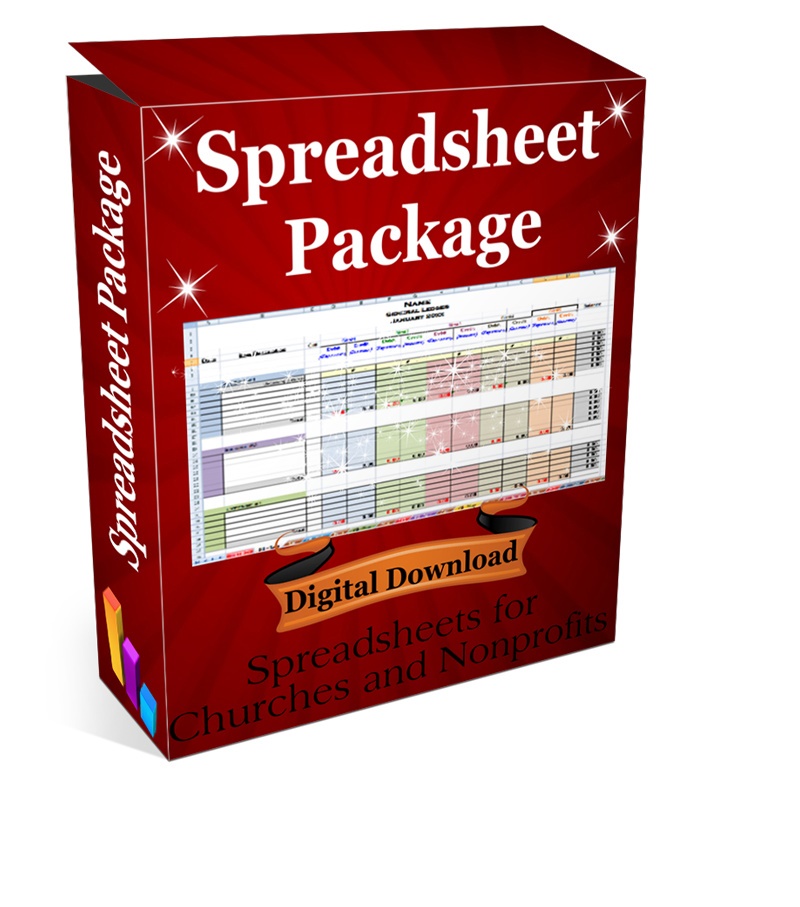
The Spreadsheet Package includes a workbook for tracking contributions, an automatic accounting workbook for tracking up to 5 funds,10 income accounts and 40 expense accounts and several more accounting workbooks. It also includes a Word document with 3 customizable contribution statements.
Comments...
Enter your title of your tip, idea, comment, or question in the text box below.
Keep the title as short as possible, but interesting enough to make people want to click on your title.
Then click on the link below it that says: Click here to see the rest of the form and complete your submission.
Write your post. Elaborate and give all the details necessary to properly convey your meaning or question,
Please be aware that with my bookkeeping company, building and maintaining websites, and my volunteer work at my church, I cannot possibly answer and comment on every submission.
However, your opinions, questions, and comments are very valuable to me...so I will try to answer questions when I can, but I am relying on the goodness of others to help here:)
Important! Comments used to go live without my approval. I would have liked to keep it this way, but there are some that take advantage of that. As a result of their blatant disregard of my request to stop posting their spam on this site... I now must approve comments first. I apologize for this inconvenience and will post your comments asap.
See more comments, tips, and Q/A from FreeChurchAccounting Readers!
The comments above are for general information purposes only and do not constitute legal or other professional advice on any subject matter. See full disclaimer.
Contributions Questions and Comments
Do you have a question or comment regarding contributions? Share it!