Method of Accounting for Nonprofits and Churches
Fund accounting is an accounting method that groups assets and liabilities according to the specific purpose for which they are to be used It keeps restricted and unrestricted funds separate for churches and nonprofits.
Save 10% on every ebook, spreadsheet & package on this site
Use code FCA at checkout
Browse the full list from the Packages menu above.
Fund Accounting with SFAS 117:
In the mid 1990’s, the Financial Accounting Standards Board (FASB) issued the Statement of Financial Accounting Standards (SFAS) Numbers 95, 116, 117, and 124.
They describe the way nonprofits should account for contributions, present their financial statements, and account for certain investments.
A few years ago the FASB organized all these accounting standards for nongovernmental organizations, including churches and nonprofits together under one title: FASB ASC Topic 958, Not-For-Profit Entities.
It didn't change any of the accounting standards for churches, just tried to simplify them by putting them all together under one topic.
The emphasis of the SFAS financial statement reporting is now on “net assets” classification, rather than tracking each fund. (Net assets means more or less the same as owner’s equity or net worth in a for-profit business.)
Church Accounting Package
A set of 2 ebook packages that covers the following topics...
- Fund accounting examples and explanations
- Difference between unrestricted and restricted funds
- Best methods for tracking restrictive funds
- Explanations and examples of financial statements for churches and nonprofits
- Minister compensation and taxes
- Payroll accounting and its complexities
- Much more - Click here for details
 Add to Cart Secure instant download
 Years ago, the net asset categories were:
- Unrestricted: These funds are donations that are available to use toward any purpose. Unrestricted funds usually go toward the operating expenses of the organization.
- Temporary Restricted: These funds may be restricted by purpose or time, but the restrictions are not permanent. An example of a purpose-restricted gift is a gift for a certain project or for the purchase of equipment. An example of a time-restricted gift is a contribution of a trust, annuity, or term endowment where the principal of the gift is restricted for a certain term of time.
- Permanently Restricted: These funds are gifts restricted by a donor for a designated purpose or time restriction that will never expire. An example is an endowment gift with the stipulation that the principal is permanently unavailable for spending, but the investment income from the principal may be used in current operations.
FASB released new standards for classifying assets and preparing financial statements in 2016!
Instead of the the three categories listed above, there is now only two classifications:
- Net assets without donor restrictions
- Net assets with donor restrictions
However, SFAS 117 and its update did not do away with accounting for funds as it concerns only financial statements, not reports used internally.
If your church does not need to report to outside agencies, you probably do not have to follow all of the specifics of the above SFAS. If you are required to have an outside audit by a donor, bank, or other organization, you will need to work with your accountant to determine how to make your financial statements GAAP compliant.
Some small churches find that tracking their financial activities internally is easier if they stay with the traditional fund accounting method. With this form of accounting you will produce reports that detail expenditures and revenues for multiple funds.
For example...you may have one fund account titled "General Fund" which all unrestricted funds (net assets without donor restrictions) pass through.
Then you may have several more funds titled "Missions", "Building Fund", etc. which restricted funds ( net assets with donor restrictions) pass through. These are funds that are set aside for a specific purpose.
Just remember that a FUND is something that has income coming in and expenses going out and is ongoing! If it is something temporary, don't set it up as a fund...track it a different way in your accounting software. In QBO, I like to track those using the "Donor/Customer" field...if you are not using QBO to track donations...which I don't recommend.
QuickBooks Online® for Churches and Not-for-Profit Organizations
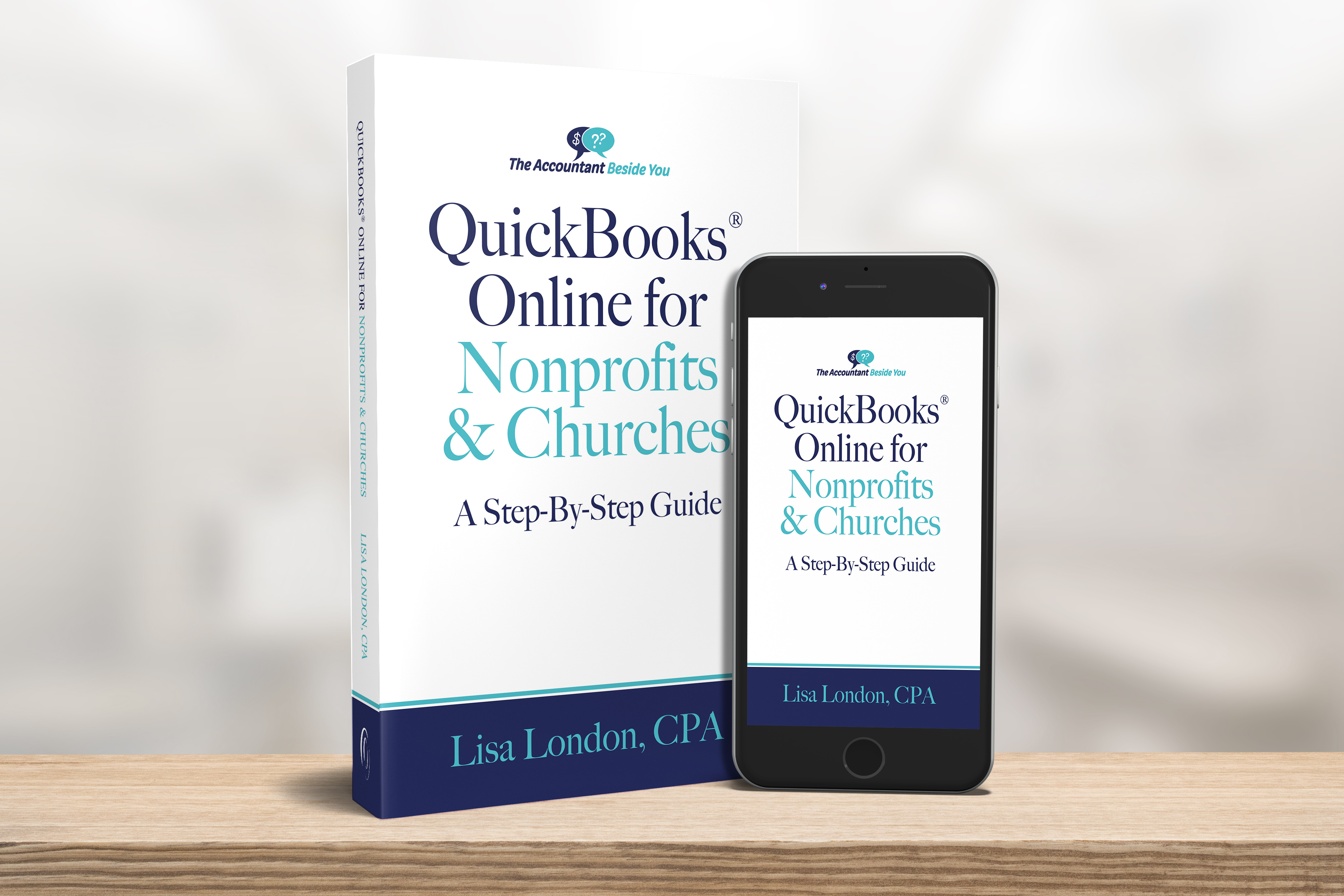
This book contains hundreds of screenshots that helps you set up and use QuickBooks Online (QBO) effectively.
Topics include:
- Procedures to guard against theft and errors
- Designing a chart of accounts (with examples for different types of nonprofits in the appendix)
- Converting a desktop QuickBooks organization into QBO
- Tracking donor gifts and grants
- Importing donor and vendor contact information
- Receiving money, paying bills, and tracking credit card charges
- Reconciling accounts
- Budgeting
- Designing management reports
- Month-end and Year-end procedures
- Tracking fundraisers, in-kind donations, volunteer hours
- Manage member dues, fundraisers, and trips
- Allocate overhead to programs & grants
- Sample charts of accounts for associations, PTAs, private schools, scouting troops, and civic groups
- And so much more!
Click to read more on this great resource book!
Fund Accounting Tips:
Tip #1 -Do not set up "too many" funds! It makes accounting tougher then it should be. If you are using specialized fund accounting software such as Alpos, use tags to track ministries such as Youth, Women's, Men's, etc. Consider using classes and customers in QuickBooks Online to track some of those donor restricted funds. Purchase QuickBooks for Churches for more detail! Click here for that book and a complete listing of the Accountant Beside You "How To" books.
Tip #2 - Do not open "too many" bank accounts! A common misconception is that you must open separate bank accounts for each fund. You don't need to.
Now that's not saying you CANNOT open separate accounts...just that there is better ways to handle multiple funds.
All funds can be placed in one bank account as long as your accounting system clearly documents net assets and liabilities in each fund apart from your operational cash flow (general fund).
Also...you must be able to produce reports that summarize the financial activities of the church or nonprofit with all of your funds.
Tip #3 - KISS (Keep it Super Simple)! You can set your church or nonprofit accounting up on paper, in spreadsheets, or through a church accounting software. No matter how you choose to set it up...it is very important to keep it simple. Remember that your set up may go through multiple volunteers or staff. It should be simple enough that the next person can step in and take over without having to learn how your complex accounting system works.
Tip #4 - Your financial administrators MUST understand the underlying concepts of nonprofit accounting and accurate financial statement preparation which is covered in the Basic Fund Accounting ebook.
Church accounting is extremely accurate, and a necessary component to any church or nonprofits financial records. However, there can be a dangerous side to it. See more on this church fund accounting guide.
Article from Bill OConnell, founder of the CPA firm: Wisdom Over Wealth:
Simplified Fund Accounting
As churches move from the season of keeping their financial records in spreadsheets, they encounter the issues of funds and accounting for funds.
Whether it be for a Building Fund, a Missions Fund, or any other project or ministry, church Treasurers eventually encounter the intimidating issue of Fund Accounting.
Funds come about in two ways:
- A donor gives money with the condition that it is restricted for a particular purpose, or;
- The governing board votes (“designates”) some of the church’s assets or future income stream for a particular purpose.
Accounting for these restricted funds and designated funds leads churches to decide they must use an accounting software product that promises “full fund accounting”. And with that decision the church embarks on acquiring an expensive and proprietary CMS system that requires staff training and vendor maintenance.
But software vendors are not the only source of confusion around Fund Accounting. Accountants add to the confusion with their jargon of “Unrestricted and Restricted”, which adds further fear and intimidation and makes everyone in the church think they into an ivory tower problem that requires great scholarship to solve.
Spreadsheet Package
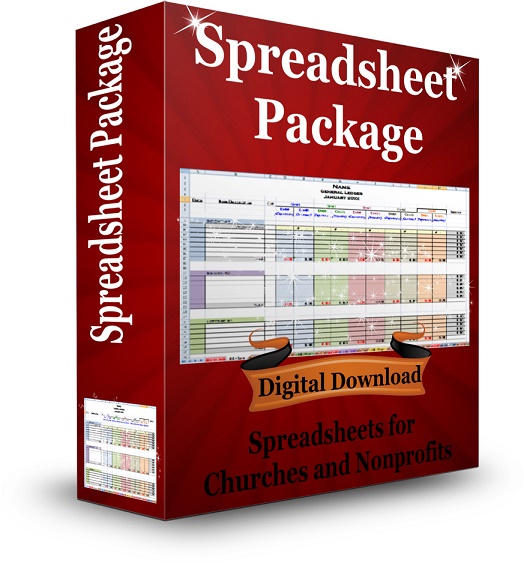
This spreadsheet package is designed for churches and nonprofits.
It includes:
- Contribution Tracker;
- Automatic Accounting (tracks income and expenses for up to 5 funds);
- Bank Reconciliation (reconciles accounting workbook to your bank statements);
- Collection Count sheet;
- Mileage log;
- Travel reimbursement
- Customizable Word doc with a Cash, Noncash, and a Quid Pro Quo Contribution Receipts.
So churches frequently resort to opening separate bank accounts for each fund. With this technique, the church achieves its fund accounting by physically segregating designated and restricted cash in separate bank accounts (A friend of ours once took the Treasurer’s position and over a two year period discovered five checking accounts, five savings accounts and two Certificates of Deposit that were not “on the books.)
However, the truth is that the issue is not as complicated as the software vendors and the accountants would have you believe. Simple business accounting software, like QuickBooks Online, is more than capable of providing fund accounting for churches.
Church Treasurers should think of funds as “a set of books within a set of books”. In our firm, we have our clients establish a small hierarchical group of accounts within the Chart of Accounts for each fund.
The church treasurer then performs all accounting (donations, spending, and transfers) within that set of accounts. At the close of each accounting period, these accounts are “closed” into a fund balance account – which we treat as an equity account inside the Fund section of the Balance Sheet.
This has the effect of making each Fund Balance available to those who read the Financial Statements – AND removing the fund activity from the operating accounting contained on the Statement of Operations. In short, the fund activity does not distort the operating results of the church.
And all this is done by any simple business accounting software. It only requires a disciplined Chart of Accounts, and some discipline in creating the monthly reports.
Comments...
Enter your title of your tip, idea, comment, or question in the text box below.
Keep the title as short as possible, but interesting enough to make people want to click on your title.
Then click on the link below it that says: Click here to see the rest of the form and complete your submission.
Write your post. Elaborate and give all the details necessary to properly convey your meaning or question,
Please be aware that with my bookkeeping company, building and maintaining websites, and my volunteer work at my church, I cannot possibly answer and comment on every submission.
However, your opinions, questions, and comments are very valuable to me...so I will try to answer questions when I can, but I am relying on the goodness of others to help here:)
Important! Comments used to go live without my approval. I would have liked to keep it this way, but there are some that take advantage of that. As a result of their blatant disregard of my request to stop posting their spam on this site... I now must approve comments first. I apologize for this inconvenience and will post your comments asap.
The comments above are for general information purposes only and do not constitute legal or other professional advice on any subject matter. See full disclaimer.
Accounting Questions and Comments
Do you have a question or comment regarding the accounting issues churches and nonprofits face? Share it!