Creating a church budget can be challenging. A budget is an action plan for the ministry and therefore a very important part of your church's overall financial health.
Below are some key points in setting up a budget for your church.
Save 10% on every ebook, spreadsheet & package on this site
Use code FCA at checkout
Browse the full list from the Packages menu above.
There are basically three budget classifications. Deciding which one is the right one to use for your church will depend on your church's individual needs.
1. Incremental budgeting, often called line item or traditional budgeting, is based on the previous year’s expenditures.
Most churches follow this budgeting process.
Incremental budgeting takes this year's budget as the basis for next year's budget and makes adjustments to each item for anticipated cost increases or activity changes.
2. Zero-based budgeting starts every program and activity at zero dollars.
3. Program budgeting evaluates all programs and activities based on effectiveness at their current levels of funding and on their potential.
See more on these budget classifications in Book 3 Audits, Budgets, and More in the Policies and Procedures series.
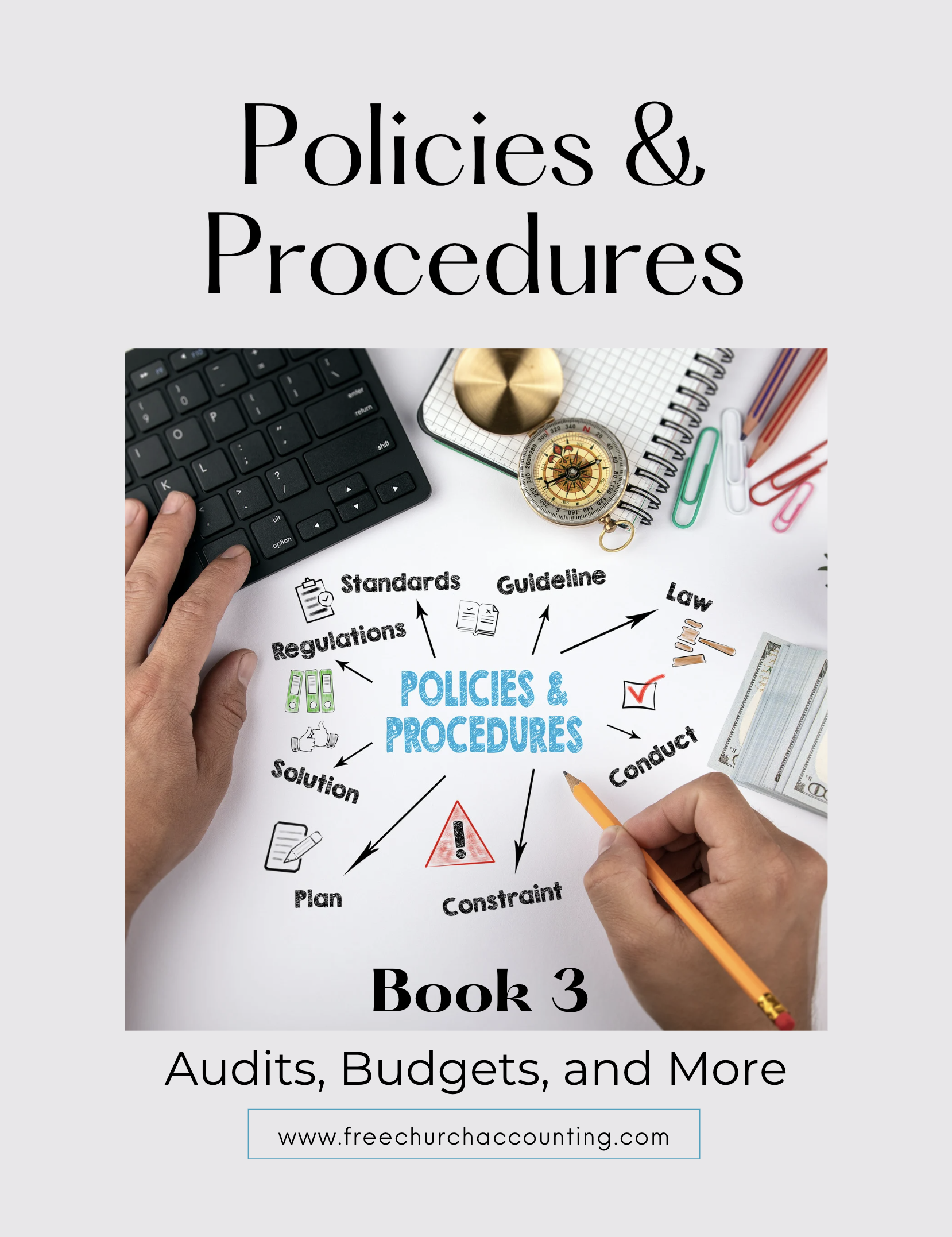
The Policies and Procedures Package includes an ebook on budgets and audits. It includes details on the different types and categories of budgets and budget tips.
This ebook is included in the Policies and Procedures Package. However, you can purchase it by itself for only $7.95 by clicking the ADD TO CART button below!
Add to Cart Secure instant download
The Audits, Budgets, and More ebook is also part of a larger "Policies and Procedures" Package" that is packed full of valuable information and for a limited time you can purchase all 5 ebooks and 8 policy templates for only $32.80
Add to Cart Secure instant downloadThe second step should be to establish a target budget amount for the upcoming year.
This could be based on funding, pledges received, past levels of giving and projected growth, assessed needs or a combination of these criteria.
Church Budget Categories:
- Income (all funds coming into the church falls into this area. Often churches will set up several line item under the "income" category to include different types of income such as tithes, building fund donations, missions donations, interest earned, etc)
- Personnel (salaries, benefits, etc.).
- Administration (operating expenses).
- Facilities and Equipment (utilities, insurance on property, maintenance)
- Outreach (missions, evangelism, social events, etc.).
- Direct ministry (the various ministries of the church such as children, youth, counseling, adult, men, women, etc.).
- See more on budget categories and budget tips in Book 3 of the Policies and Procedures series
I use traditional (incremental) budgeting for my church and most of my clients. Aplos has a wonderful budgeting module and QuickBook Online (QBO) is pretty easy to input as well.
We do most of them in October, so my first step in preparing a church budget is to run a Statement of Activity from October of the prior year to September of the current year. I export it into a spreadsheet and add a column for the budget. By having a year worth of income and expenses in the first column from the Statement of Activity, it is much easier to anticipate the new year's budget.
Be aware that in QBO you will need to do several budgets if you are using classes to track designated funds. I do a "Total" one with everything in it and then do smaller ones for the different ministries and programs. Same thing for Aplos.
Do generate a Budget to Actual report EVERY month! This is a very useful tool and will provide you with invaluable information.
Church Budget Tips:
I have noticed a common trend - people tend to vanish when the topic of budget preparation arises=)
Perhaps this disappearing act is due to the time-consuming nature of budgeting, especially in our current economic climate, where estimating income and expenses can be quite challenging.
To make this task more manageable and prevent your colleagues from vanishing, here are some budgeting tips to consider:
- Divide and Conquer: Establish general yearly goals but focus on creating more detailed budgets on a monthly or bimonthly basis. Monthly budgets can provide a clearer picture as donations fluctuate, and one-time annual expenses can be accurately reflected.
- Stay Flexible: Remember that budgets are estimations and not set in stone. Regularly review and adjust your budget based on actual figures. If certain expenses exceed projections, reallocate funds accordingly.
- Monitor Cash Flow: Keep a close eye on your cash flow and ensure you have enough funds to cover all financial obligations. Adjust expenses if donations do not align with projections, and consider investing surplus funds wisely.
- Seek Expert Advice: Consult with a CPA, financial advisor, or banker to develop a tailored budgeting system for your organization.
Remember, once your budget is finalized, keep it accessible and review it regularly. Utilize monthly budgets as effective financial management tools to anticipate donation trends and prepare for lean periods.
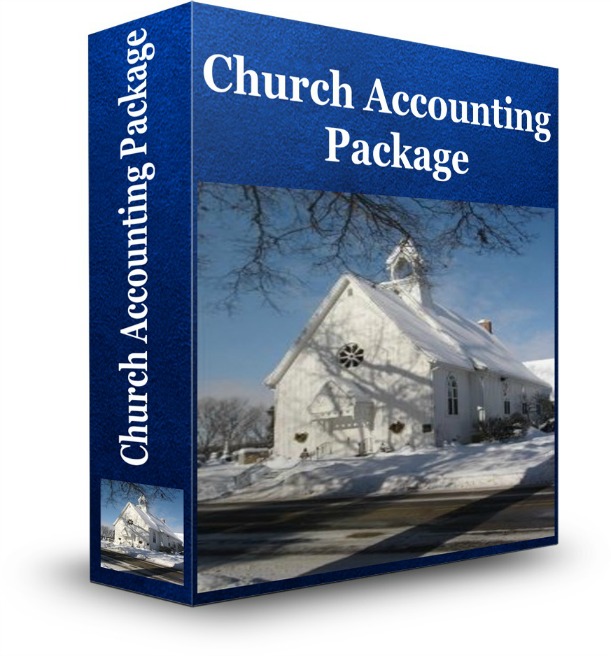
Church Accounting Package
A set of 2 ebook packages that covers the following topics...
- Fund accounting examples and explanations
- Difference between unrestricted and restricted funds
- Best methods for tracking restrictive funds
- Explanations and examples of financial statements for churches and nonprofits
- Minister compensation and taxes
- Payroll accounting and its complexities
- Much more - Click here for details
 Add to Cart Secure instant download
 Tips on Cutting Church Budget Expenses:
Finances always are a delicate subject in any church or nonprofit. Without adequate funds, your organization cannot continue to minister effectively. Part of an effective ministry is meeting your financial obligations.
It is important to protect your organization's reputation in your community, to your bank, staff and vendors.
It is a sad situation when a church is not able to pay its bills on time or has to ask its staff members to hold their pay checks until after Sunday's offering or when more funds become available.
Here is some tips on cutting costs:
- Fundraisers: Delegate the organization of bake sales and car washes to the youth director to support youth ministry expenses. Consider convening a meeting with the church's ladies to establish a Fundraising Committee if one does not already exist. Most people are willing to contribute if asked. Avoid overburdening one or two individuals with all fundraising responsibilities to prevent burnout.
- Offerings: If contributions are decreasing, provide opportunities for giving at each service or event. While some churches collect offerings only once a week, not all members may attend that particular service. Encourage consistent giving by reminding members about the church's financial challenges during sermons and other communications. Emphasize the importance of their ongoing support in sustaining the church's activities.
- Spending Cuts: Small measures can make a significant impact, such as requesting donations of snacks from church members for meetings or events, ensuring lights are switched off when not needed, adjusting the thermostat, and encouraging the donation of unused supplies from the nursery, kitchen, and office by mem
So prepare your church budgets carefully and prayerfully. We are to be good stewards of the funds God entrusts to us, and part of that responsibility is to meet our financial obligations in a timely manner.
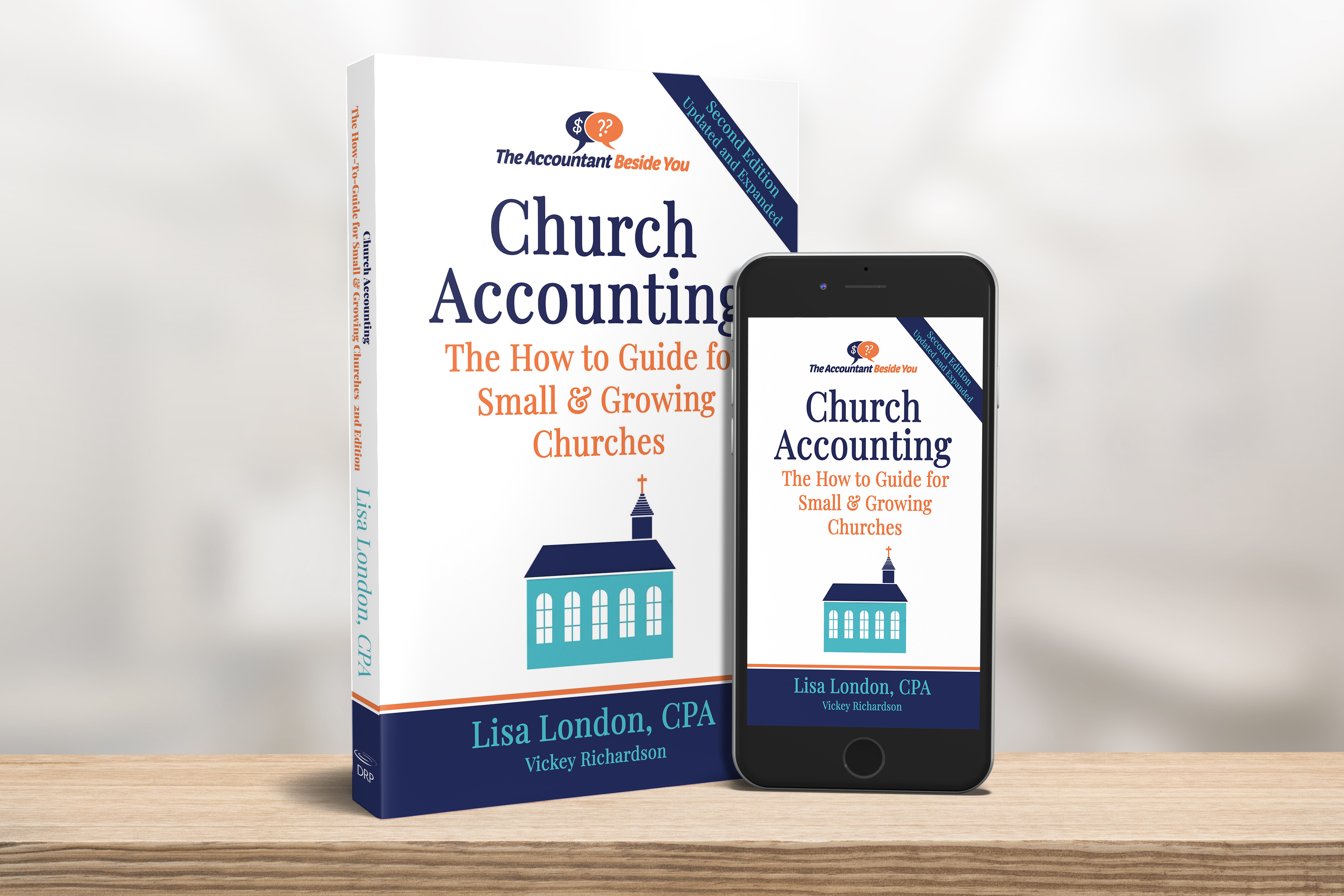
There is a whole chapter devoted to church budgets in Lisa and my book "Church Accounting - The How to Guide for Small and Growing Churches"
The Budgeting for Churches chapter include:
- The process necessary to prepare a budget
- How to do monthly budgeting
- The difference between budgets and forecasts
- How to use your forecast for analyzing cash flow
See more details on this valuable resource book!
Use coupon code "FCA" for a 10% discount!
Comments...
Enter your title of your tip, idea, comment, or question in the text box below.
Keep the title as short as possible, but interesting enough to make people want to click on your title.
Then click on the link below it that says: Click here to see the rest of the form and complete your submission.
Write your post. Elaborate and give all the details necessary to properly convey your meaning or question,
Please be aware that with my bookkeeping company, building and maintaining websites, and my volunteer work at my church, I cannot possibly answer and comment on every submission.
However, your opinions, questions, and comments are very valuable to me...so I will try to answer questions when I can, but I am relying on the goodness of others to help here:)
Important! Comments used to go live without my approval. I would have liked to keep it this way, but there are some that take advantage of that. As a result of their blatant disregard of my request to stop posting their spam on this site... I now must approve comments first. I apologize for this inconvenience and will post your comments asap.
The comments above are for general information purposes only and do not constitute legal or other professional advice on any subject matter. See full disclaimer.
Budget Questions and Comments
Do you have a question or comment regarding the budgeting issues churches and nonprofits face? Share it!